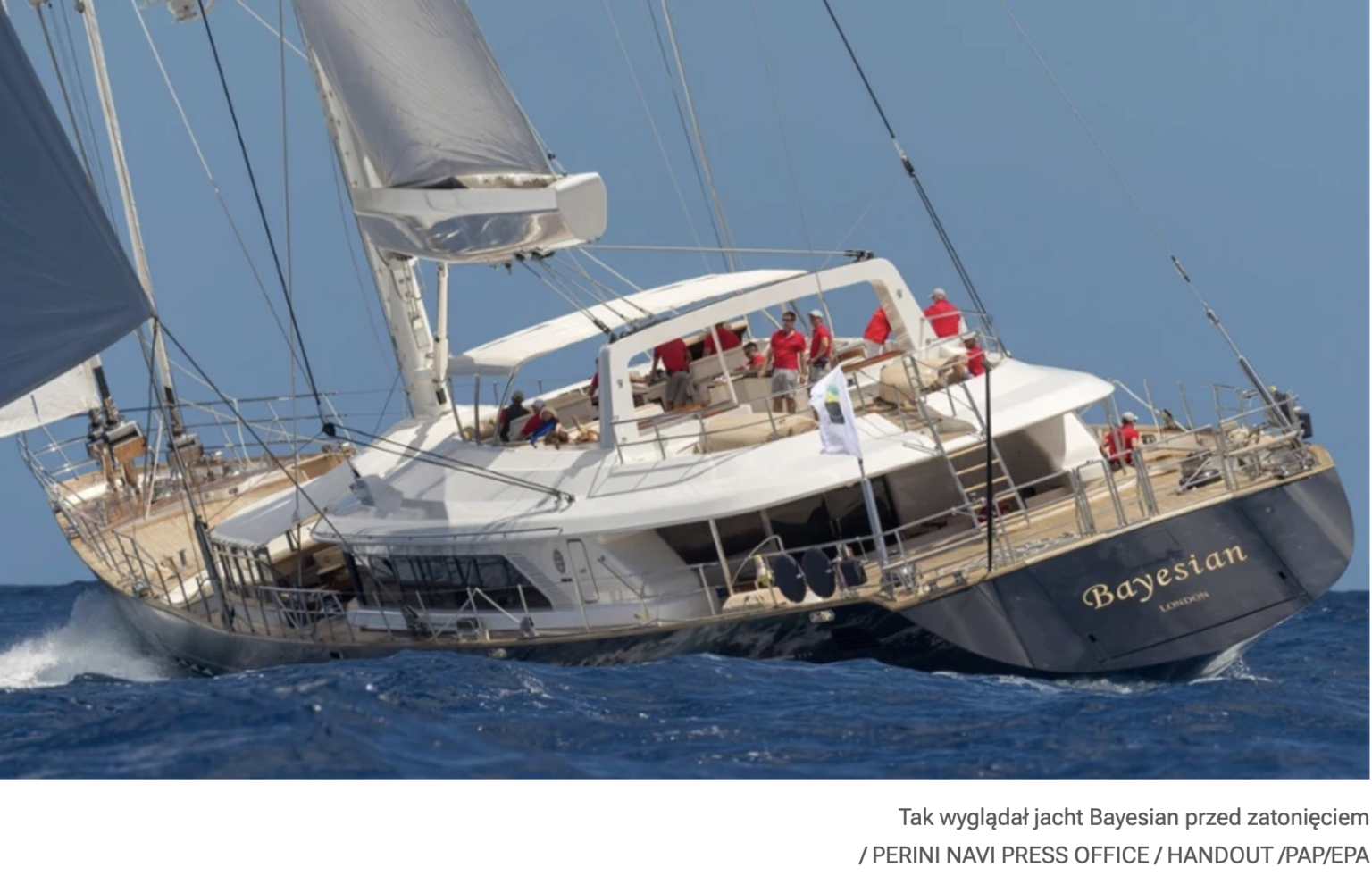
Dispute over Bayesian – when a shipyard sues a yacht’s owners 

The sinking of the superyacht Bayesian in August 2024 was a human tragedy. 

Today, it is also becoming one of the most fascinating legal disputes in the field of yacht law, covering the responsibility of the shipowner, the crew, and – indirectly – the shipyard itself. 

The case attracts attention not only due to the scale of the claims (about 790 million USD) but primarily because of the unusual role of the shipyard, which is suing the owner and the crew of the vessel, claiming that their actions have damaged the shipyard’s brand reputation. 

This is a rare and potentially groundbreaking situation. 

What happened on the Bayesian 

The Bayesian was a 56-meter sailing superyacht built by the Perini Navi shipyard, which was acquired in 2021 by The Italian Sea Group. 

The vessel was famous for its record-high, aluminium mast. 

On August 19, 2024, the yacht sank while anchored in Porticello, Sicily, as a result of a violent storm. 

Seven people lost their lives, including the owner – British tech entrepreneur Mike Lynch – and his daughter. Among the survivors was his wife, Angela Bacares, the owner of Revtom Ltd., the formal shipowner of the yacht. 

Following the accident, an investigation was initiated by the Marine Accident Investigation Branch (MAIB), the British counterpart of our Polish State Commission for Investigation of Marine Accidents (PKBWM).

Findings of the MAIB investigation 

The MAIB, with the support of experts from the University of Southampton, determined, among other things, that: 

  • in the configuration of the yacht on the day of the accident (engine running, sails lowered, keel raised, low fuel levels – generally a high center of gravity),
  • the vessel was susceptible to capsizing with a crosswind exceeding 63.4 knots,
  • meteorological simulations indicated the possibility of gusts exceeding 87 knots,
  • about 50% of the heeling moment was due to the wind load on the exceptionally tall mast. 


However, there is something else that is crucial – these characteristics were not described in the stability documentation available on board.

As a result, neither the owner nor the crew were aware of the actual danger in such conditions. 

The MAIB clearly stated that the report is not intended to assign blame and is not meant to be used in legal proceedings. 

And it is precisely at this point that the real legal dispute begins. 

Shipyard lawsuit: a technical defense or a brand image offensive? 

The Italian Sea Group has filed a lawsuit against: 

  • Revtom Ltd. (the shipowner),
  • the captain and two crew members. 

The claim is clear-cut:

– the cause of the sinking was the crew’s operational negligence, not the yacht’s design or construction. 

The shipyard also argues that: 

  • the disaster led to a collapse in demand for Perini Navi yachts,
  • no new unit of this brand has been sold since the accident,
  • there has been a loss of business relationships, a decline in the company’s value, and reputational damage. 

And I must admit, this is a very interesting and bold legal strategy. 

Case from perspective of yacht law 

  1. Manufacturersues the customer 

In yacht disputes, we more commonly see the reverse situation: the shipowner sues the shipyard for defects, delays, or design errors. 

Here, the shipyard goes on the offensive, attempting to shift full responsibility onto the yacht’s user. 

  1. Crew’sResponsibility vs. shipowner’s responsibility 

From the perspective of maritime and yacht law, the shipowner is generally responsible for the actions of the captain and the crew (although the details of this responsibility may differ in some legal systems). 

This opens the way for claims – but (again, generally) only when the crew’s actions are negligent, clearly proven, and constitute the primary cause of the damage (this is when we talk about a causal link between the actions and the damage). 

  1. Technicaldocumentationas a flashpoint 

The issue arises, however, if the dangerous characteristics of the vessel were not disclosed in the documentation. The question then becomes:

  • can we talk about the crew’s negligence if they were acting within the knowledge provided by the manufacturer? 

This question will likely be one of the most important in the trial. 

Will anyone want to buy a yacht from a shipyard that sues its owners? 

This is a non-legal aspect, but it is extremely important. 

The superyacht market is based on: 

  • trust,
  • long-term relationships,
  • a sense of „partnership” between the shipowner and the shipyard. 

A potential client may today ask themselves a very simple question: 

„What will happen if an accident occurs? Will the shipyard stand by my side, or against me?” 

Even if the lawsuit turns out to be legally justified, the chilling effect on the market is a real risk. 

Defending a brand in court – is this the right approach?

From a legal perspective, the answer is: 

– this is a strategy fraught with high risk.

  • A court case solidifies the association of the brand with the disaster.
  • A public dispute with the widow of the deceased owner creates reputational risks.
  • Engaging in a debate with the findings of the MAIB (even if they are not formally admissible as evidence in the case) is difficult from a communication standpoint. 

Sometimes, a more effective brand defense strategy involves: 

  • transparency,
  • collaboration in determining the causes,
  • modifying design or documentation standards, 

rather than an aggressive legal offensive. 

Conclusions 

The Bayesian case is one of the most fascinating contemporary cases in yacht law, as it combines: 

  • the responsibility of the shipowner and crew,
  • design and informational risks,
  • the reputational responsibility of the manufacturer,
  • and the question of the boundaries of judicial „brand defense”. 

Regardless of the outcome of the trial, this dispute will be closely analyzed within both the legal and yachting communities for a long time. It is highly likely that it will influence how shipyards will approach the construction of technical documentation, contracts, and crisis management strategies in the future.

Multihulls – the rising stars in the yachting market 

In recent years, multihull yachts have gained popularity. Although their concept was born long ago, they have only recently achieved success in recreational sailing.

What is a multihull?

A multihull is a vessel that has more than one hull. A vessel with two hulls is called a catamaran, while one with three hulls is a trimaran. Very rarely, there are vessels with more than three hulls, typically used for specialized purposes. 

Advantages and disadvantages of multihulls 

  • Stability and safety – one of the greatest advantages of multihulls is their high stability, resulting from their wide beam. Compared to monohulls, they have significantly smaller heeling angles during sailing, which increases crew comfort and a sense of safety.
  • Speed – multihulls often achieve higher speeds than monohulls of the same length, mainly due to lower hydrodynamic resistance and the lack of ballast. This allows for more efficient sailing, especially on favorable courses and wind conditions.
  • Space – with two hulls, there is significantly more space, both inside and outside. This provides more room for cockpits, storage, and other amenities.
  • Maneuverability – multihulls typically have two separate engines, one in each hull. This allows the yacht to rotate in place, providing greater control and reducing the impact of tides and wind during navigation.
  • Comfort – all of the previously mentioned factors contribute to greater comfort while sailing, especially for families and people prone to seasickness.
  • Experience – some argue that multihulls do not offer the same sailing experience as monohulls. Monohulls are less stable and more susceptible to wind and waves, making sailing more exciting.
  • Transport – monohulls are smaller, and thus easier to transport. If you plan to transport your boat, this is something to consider when making a purchase.
  • Maintenance – a hull requires regular cleaning and protection. Having more hulls means more work or costs. The same applies to engines.
  • Costs – multihulls are more expensive to produce, and therefore, their price is higher.

Important provisions in the sales agreement 

If you’ve already decided on a multihull, it’s important to pay attention to specific provisions in the sales agreement related to this type of vessel, which should address: 

  • responsibility for inspecting each hull individually,
  • structural condition of the crossbeam (i.e., the wider beam – cross elements running between the hulls),
  • a detailed handover protocol, divided by hulls and onboard equipment,
  • conditions for rejection after a survey revealing structural defects,
  • costs of testing and insurance (which will typically be covered by the buyer). 

The agreement should also specify how the multihull yacht will be handed over. Due to the size of these vessels, the transport cost is significantly higher compared to monohull equivalents. It’s important to define whether the handover will take place on land, on water, or ready for further transport. 

For more information on yacht sales agreements, see here: Pitfalls in yacht acquisition agreements – how to avoid troubles?

For tax-related matters related to the purchase, see here: New yacht and VAT – do you need to pay and when?

Market situation 

The market for the most popular multihulls, catamarans, is growing dynamically. Depending on the source, its value is estimated to be between 900 million and 2.2 billion dollars. In 2024, according to analysts, catamaran sales doubled compared to the previous year, accounting for one-third of total yacht sales. Forecasts predict continued, intense growth in the coming years – by 2030, the market value is expected to reach between 1.5 billion and approximately 3 billion dollars.

source: https://www.mordorintelligence.com/industry-reports/catamaran-market

source: https://www.marketgrowthreports.com/market-reports/powered-catamaran-market-107733

Summary 

Multihull yachts are increasingly asserting their position in the yachting market, becoming an attractive alternative to monohulls. With high stability, more space, excellent performance, and enhanced sailing comfort, they are particularly well-suited for recreational, family, and charter sailing. However, they require an understanding of their specifics – higher purchase and maintenance costs, greater service requirements, and a somewhat different “sailing experience.” The dynamic growth in sales and optimistic market forecasts indicate that multihulls have already become one of the most important segments of the modern yachting market.

Why a client should not wander around the law office?

Do you know that slight unease before visiting a doctor? Especially for the first time? Will they listen to me? Will they understand me? Will I understand them? Will I forget to mention something? And depending on personal traits, the rest of the similar dilemmas.

Yes, this is another reference to doctors, because – just like with lawyers – we don’t go to them for trivial matters but for problems. And with all due respect to other professions, it’s easier to deal with a bad haircut or a leaking washing machine than with the prospect of surgery or imprisonment. 

The stress level before the first meeting with a lawyer can, of course, be very high, depending on the matter we’re bringing in. In the mindset of many people, a visit to the law office is a last resort, a sign that something went wrong in their business (or life) and they can’t handle it. While many entrepreneurs’ awareness is changing, for a large portion, a lawyer is still seen as someone who puts out fires. And when there’s a fire, it’s a disaster. 

The client walks in and doesn’t know what to do 

So, this client walks in, stressed about their situation and the fact they need to tell someone about it. It’s great if they immediately see someone in an obvious spot, so there’s no doubt that they can approach them. It’s worse if there’s no clear place, or no one they can speak to. It feels a bit like standing at the entrance of a restaurant, seeing a sign that says, “Please wait here,” and then no one comes to greet you for the next ten minutes – not even a glance. 

Let’s assume the client enters the office, sees the reception desk, but there’s no one behind it. No one acknowledges their arrival, and they stand there, waiting. They look at their watch – the meeting is in a minute, but they left early to avoid being late. They start nervously moving around, and eventually peek into the rooms, apologizing for interrupting, and explain they’re there for a scheduled meeting.

Has their stress level increased before the meeting? Definitely. Perhaps this situation even irritated them a little. Did it make them wonder if anyone is working here? If anyone is engaged? It might, especially if they pay attention to such things or if customer service in their own business works very differently. Finally, did they feel safe in this situation? Comfortable? Certainly not.

Our core value is safety 

We don’t let situations like this happen. In our Client Service Procedure, we clearly define that during office hours, someone must always be at the reception desk. We know who is filling in and when, and what to do if the reception desk is temporarily empty. There is absolutely no option for a client not to know what to do, where to go, or not to be welcomed and invited into a conference room, or asked to wait. And absolutely everyone must be able to do this and feel responsible for it. No matter how complex their tasks may be, everyone should be ready to help the client. 

A client must feel safe and comfortable in the office – not only in the substantive aspect but also in the organizational one. That’s why procedures are necessary. The first contact can truly make a significant difference.