
Law and offshore in practice – takeaways from the 14th International Offshore Wind Logistics & Supplies Conference
Events /
30 October 2025
This year’s PIMEW conference took place in Gdańsk and was one of the most important industry events in Poland’s offshore wind sector. Center stage went to investors, representatives of public administration, state-owned companies, developers, suppliers and… of course, law firms.
The main themes that dominated the conversations and panel discussions were:
- building a domestic supply chain,
- the need for regulatory coherence,
- the role of financing and institutional support,
- the issue of local content, including its relationship with public procurement law,
Polish supply chain
During the opening panel, there were many strong statements about the need to build a “local supply chain”. Presentations by PGE Baltica, Orlen Neptun, ARP, Ocean Wind, Tele-Fonika Kable, and CRIST Offshore showed that the sector is determined to increase the share of Polish enterprises in delivering offshore investments.
The problem is that there is still a lack of effective legal and methodological tools to verify the actual share of the Polish component (local content). As a result, even projects involving domestic companies are not always formally recognized as “Polish”.
In practice, this means that Polish enterprises often compete on uneven terms with international corporations that have greater experience, capital, and project resources.
From a legal perspective, this problem opens up new challenges for support services:
- drafting consortium agreements between Polish and foreign entities,
- introducing clauses that guarantee the participation of local (sub)contractor,
- developing contract models that account for the local content requirement in tenders,
- analysing non-price criteria within public procurement and private offers.
The panel repeatedly emphasized the importance of transparency in partner selection – and the need to ensure Polish suppliers have real access to contracts. There was discussion on how to limit the role in intermediaries and enable direct cooperation between local suppliers and wind farm developers.
An additional issue is how assumptions regarding local content relate to the public procurement law. According to the law, public contracts should be equally open to Polish entities and to those from across the EU. Reconciling these two regimes is a major challenge for the offshore sector.
Formal and legal coherence of the investment process
One of the most interesting panels was devoted to the first permit in Poland for the operation of an offshore wind farm. A session with representatives of the Provincial Inspectorate of Building Supervision showed just how complex the formal procedures are in offshore projects.
Speakers pointed out that the current construction and environmental regulations are not tailored to the specifics of offshore energy investments. There is a lack of clear rules defining how to reconcile requirements arising from construction law, the Act on the Maritime Areas of the Republic of Poland, environmental protection, and energy law.
In practice, many administrative decisions rest on interpretation and individual arrangements with authorities. Developers often encounter difficulties in obtaining permits, and the investment process becomes significantly prolonged.
The discussion raised the proposal to introduce an integrated permitting system – similar to the Danish or British model – in which all necessary decisions would be issued within a single administrative proceeding.
From a legal standpoint, this would mean creating a new category of maritime investments for which uniform procedures and documentation and technical standards would be developed. This, in turn, would be a major facilitation for both investors and the administration.
Financing
The topic of financing offshore projects kept resurfacing at the conference. One of the biggest problems for Polish contractors is the so-called negative cash flow – the need to fund the initial stages of a project from their own resources before payments from the investor/contracting authority arrive.
This phenomenon effectively sidelines many smaller enterprises that lack sufficient capital or access to long-term lending.
Several solutions were proposed during the discussion that could mitigate this problem:
- introducing dedicated escrow accounts,
- using bank guarantees instead of cash securities,
- stage-based project settlements (so-called milestone payments),
- enabling financial institutions to participate in contractor consortia.
From a law firm’s perspective, this is an area where real support can be offered to businesses – among other things by negotiating EPC contracts, assessing contractual risk, and developing financial-legal structures that minimize liquidity risk.
Contracts
Contracts in offshore wind are among the most complex in the construction market – not only because of the scale of the investments, but above all due to the number of participants and the conditions of the environment in which the works are carried out. EPCI (Engineering, Procurement, Construction and Installation), FIDIC, and hybrid contracts require precise allocation of the parties’ responsibilities, as well as a balance of interest between the investor, the general contractor, and (local) subcontractors.
In practice, numerous legal issues arise here – from matters of quality and timeliness guarantees, through weather-related risks, to liability for delays in the delivery of components. An additional challenge is cross-border agreements governed by foreign legal regimes.
Experts noted that proper contract preparation today is not only a matter of regulatory compliance, but also of effective risk management. Elements such as the following are key:
- risk matrices,
- permissible liability caps,
- compensatory mechanisms in the event of interruptions to the works.
Attention was drawn to the need for broader use of alternative dispute resolution (ADR) methods – such as industry mediation or adjudication – which help avoid years-long court proceedings and preserve business relationships between the project parties.
Polish shipowners and shipyards in the offshore wind sector
Polish shipowners (though there aren’t many of them) want to enter the construction and later maintenance (O&M) of offshore wind farms, but they lack suitable vessels and stable contracts. Service vessels (CTV with DP2, SOV/CSOV) require costly upgrades and stringent HSE and class certificates. Crews must have GWO training and “offshore” experience, which drives up costs. Contracts often shift weather and delay risks onto the shipowner, and contractual penalties are high. Entering the supply chain is difficult without prior references from wind farm projects.
The topic of building a jack-up for turbine installation keeps coming back – most realistically in the context of phase II. We have the shipbuilding capabilities, but we lack a shipowner who would decisively and unequivocally take responsibility. A similar situation applies to a cable-laying vessel (CLV), although here investor work (TFK) is moving forward. In both cases the CAPEX is very high and certification is lengthy, so the project’s bankability should be based on a long-term charter or a framework agreement.
Polish shipyards, however, still have a very real space to deliver smaller units:
- new CTVs,
- SOV-CSOV,
- conversion for “walk-to-work”,
- as well as components and upgrades for jack-ups and cable layers (e.g., cable carousels, gangways, DP systems, lay-spread integration).
Demand for class renewals, HSE outfitting, and rapid refits will grow in step with construction and O&M schedules in the Baltic. Additionally, shipyards can partner with cable manufacturers and lifting equipment suppliers to create complete “design-build-integrate” packages for shipowners.
Concrete proposals and takeaways for the industry emerged:
- Pre-qualifications and pilot projects: shipowners should get onto developers’ approved suppliers lists as soon as possible and secure short pilot project contracts. This builds the references needed for larger agreements.
- Financial “carried” contracts: for jack-up or cable-layer projects, it’s worth aiming for a long-term charter or a framework agreement with a guaranteed package of days. This facilitates lending and guarantee support.
- Shipyard + shipowner + supplier bundles: Polish shipyards and shipowners can jointly offer turnkey solutions (design, build/conversion, integration, service). This shortens time to implementation and boosts competitiveness.
- Ports and slots: reserve port resources and yard slots early, because parallel projects quickly “eat up” infrastructure availability.
- Clear contractual risk allocation: negotiate sensible KPIs, transparent stand-by and weather terms, offshore insurance, and penalty caps – otherwise the cost of capital will simply wipe out the entire business margin.
If we combine shipowners’ needs (vessels, certification, references) with shipyard’s capabilities (newbuilds, rapid conversions, systems integration), the Polish supply chain can genuinely enter the construction and O&M segment in the Baltic.
Short pilot (perhaps even in phase I), smart financing, and joint turnkey bids will be crucial – even for ambitious projects like a jack-up and a cable-laying vessel.
Summary
This year’s PIMEW conference leads to clear conclusion: Poland’s offshore sector is entering a new stage of maturity, but it needs support at the legislative, financial, and organizational levels.
The conference showed that the role of lawyers in offshore projects no longer boils down to “paperwork”. Contemporary advisory work in this sector requires an understanding of the technical, financial, and operational logic of the investment.


Other events

Baltic Economy Congress 2025 – Security on the Baltic Sea, the development of Western Pomerania and offshore investments
Events / 26 November 2025
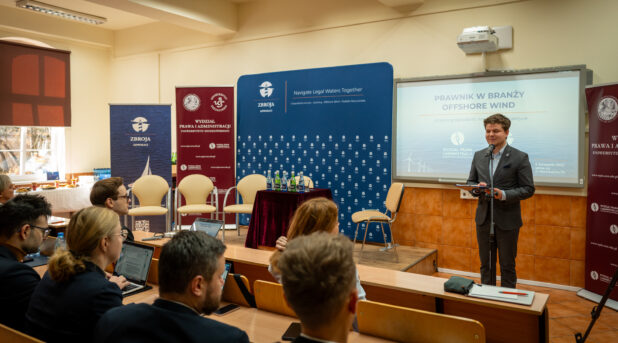
Report from the conference “Lawyer in the offshore wind sector – maritime economy law in practice” through the eyes of the lawyers from Zbroja Adwokaci
Events / 5 November 2025
Polish-Danish offshore wind supply chain grows in Szczecin
Events / 24 September 2025
The Scandinavian-Polish Chamber of Commerce
Events / 24 September 2025